Venezuela was the unlikely star of last week’s IMF-World Bank Spring Meetings. While most conversations in Washington centered on falling economic forecasts and the cost of the Middle East conflict, investors and officials kept circling back to one topic: Venezuela’s defaulted debt — and the growing hope that a restructuring is finally within reach.
“The permafrost is melting. And that is why investors are optimistic,” said Rodrigo Olivares-Caminal, a professor at Queen Mary University who advises governments on debt.
The excitement was palpable. At least six banks and organizations — including Bank of America, Barclays, JPMorgan, and Morgan Stanley — held crowded investor briefings on Venezuela during the meetings. None of it was on any formal agenda. It all happened on the sidelines.
IMF and World Bank re-engage with Caracas
Late on Thursday, the IMF and World Bank announced they had resumed dealings with Caracas for the first time since 2019. The move is a major step toward re-engagement with the international community. It could also unlock roughly $5 billion in IMF special drawing rights — a reserve asset allocated by the Fund.
The recognition was expected by markets. Still, it added to the positive mood because it opens the door to technical assistance and the Fund’s detailed economic assessments. Those assessments, in turn, can help determine what level of debt is sustainable — laying critical groundwork for any restructuring.
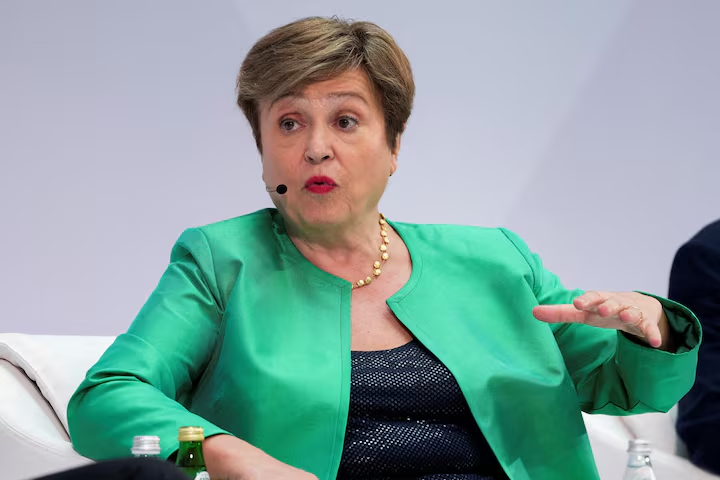
IMF chief Kristalina Georgieva said the Fund would likely provide Caracas with a financial support program. But she cautioned that it would be “a very tough road” to restore macroeconomic and financial stability.
The scale of the debt challenge
The numbers are staggering. Venezuela and its state oil firm PDVSA have roughly $60 billion in defaulted bonds outstanding. But total external debt expected to be in scope for restructuring could reach $150 to $170 billion. That figure includes obligations from the energy firm, bilateral loans, and international arbitration awards.
If a restructuring is achieved, it would be one of the largest in recent history. Six attendees who spoke to Reuters — including bondholders and lawyers — said they hoped warmer U.S.-Venezuela ties would make it possible.
What changed politically
The shift in sentiment traces back to Donald Trump’s return to office at the start of last year. That prompted early bets on regime change. Those bets proved correct when a U.S. military operation in January resulted in the seizure of former President Nicolás Maduro, who is now in a New York prison.
Since then, closer ties between the Trump White House and interim Venezuelan President Delcy Rodriguez have fueled market optimism. Prices on some Venezuelan bonds have climbed to their highest levels in roughly a decade.
Georgetown Americas Institute fellow Juan S. Gonzalez — who served as Deputy Assistant Secretary of State for the Western Hemisphere — gave three talks during the meetings. All three were packed. “Rejoining the IMF and getting access to the SDRs allows Delcy Rodriguez to lay the groundwork for debt restructuring,” he said.
Opposition leader Maria Corina Machado also featured in the discussions. At a Barclays roundtable, advisers to Machado said she expects to return to Venezuela before the end of 2026 and is pushing for swift elections.
Caution remains
Not everyone is rushing in. JPMorgan analysts acknowledged the case for a swift restructuring of international bonds. However, they said there’s been little sign it would happen quickly or separately from a broader process.
“We do not yet have any sense a narrow restructuring of bonded claims would move forward quickly and separately from a more comprehensive restructuring,” JPMorgan wrote.
Meanwhile, the broader backdrop remains complicated. The Middle East conflict dominated much of the Spring Meetings, with surging oil prices driving inflation fears worldwide. For Venezuela — home to the largest proven oil reserves on the planet — high prices could mean extra revenue to repair decades of crumbling infrastructure.
Whether that optimism translates into concrete action remains to be seen. But for now, Venezuela is the trade that Wall Street can’t stop talking about.