
A commercial conflict involving Egypt’s state grain buyer has intensified scrutiny over the way the country has handled imports since abandoning its long-standing public tender system.
According to two people with direct knowledge of the matter, a Ukrainian supplier loaded roughly 12,000 metric tons of sunflower oil in July under an agreement with Future of Egypt, the military-linked agency now responsible for strategic purchases. The cargo left port without the standard financial guarantees, and the payment expected from the agency never arrived.
Faced with the loss, the supplier turned to a UK-based trade institution that handles commercial disputes between exporters and buyers. It remains unclear whether the case advanced through the institution’s internal procedures or was addressed informally between the parties. One of the associations contacted for this story said it had no open case involving Future of Egypt.
The episode is one of several that have unsettled global traders over the past year. In another case, a French wheat exporter warned of legal action after waiting months for the agency to open a letter of credit for a May shipment. The cargo was eventually loaded in July, after the financial guarantee was issued, but only with added demurrage costs.
For decades, Egypt relied on an open tender system run by the General Authority for Supply Commodities (GASC), which offered transparency and predictable payment terms. The shift to direct, informal negotiations under Future of Egypt has changed that dynamic.
Six international traders said agreements are now often made privately, sometimes by phone, and followed by delays, attempts to change prices after global markets move, or requests to postpone previously confirmed deliveries.
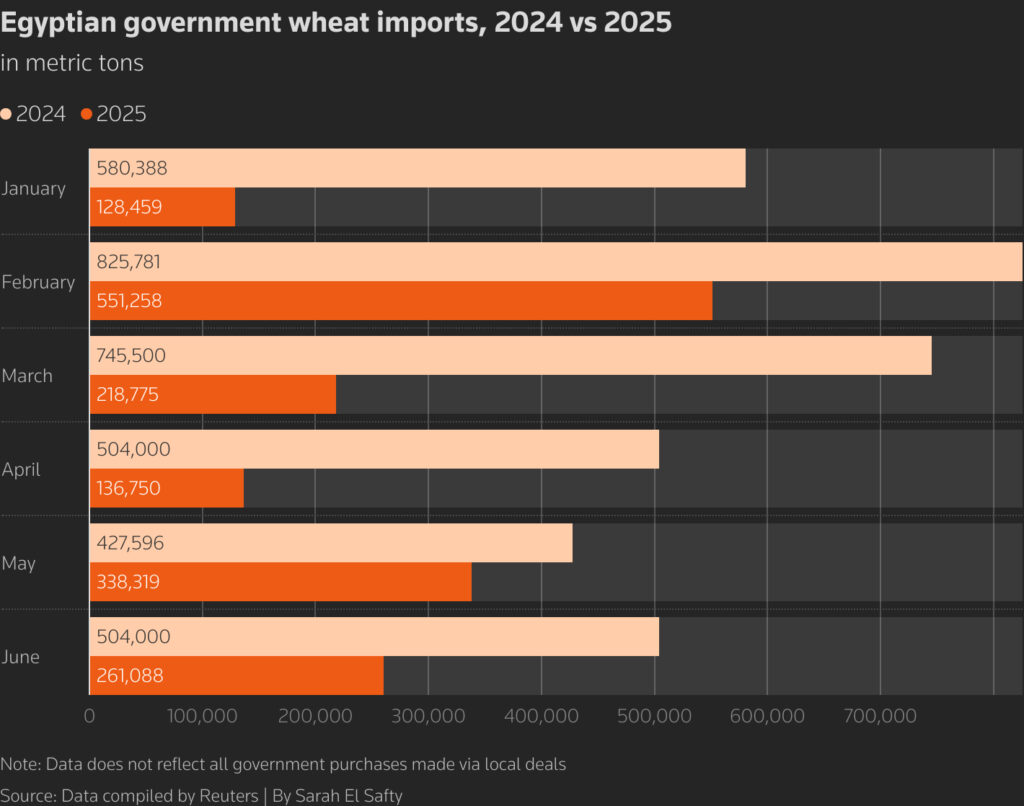
These practices contributed to a sharp drop in state wheat imports in the first half of 2025, pushing stocks to their lowest level in years. At one point in April, Egypt held barely over a month of supplies in storage, according to one trader and a second person familiar with internal records. The shortfall eased only when the domestic harvest arrived.
Some confidence has been restored since the recent appointment of Yousria Yusry Mohamed, a former GASC official, to supervise international purchasing. Several suppliers say recent payments have been released more smoothly, and the agency has resumed placing orders with some of its long-standing partners.
Still, caution prevails. One executive at a major global supplier said his company is withholding new deals until it sees repeated evidence of timely payments, firm commitments, and clear guarantees before vessels are loaded. For a country that depends heavily on imported grain to feed tens of millions of people, that trust is as essential as the commodities themselves.




![Terry Rozier pleads not guilty to sports betting charges By Reuters December 8, 20257:45 PM GMT-4Updated 3 hours ago Item 1 of 3 Terry Rozier, a guard with the NBA's Miami Heat, departs the Brooklyn Federal courthouse, after entering a plea in a criminal case alleging he shared non-public information with sports bettors ahead of games, in Brooklyn, New York, U.S., December 8, 2025. REUTERS/Eduardo Munoz [1/3]Terry Rozier, a guard with the NBA's Miami Heat, departs the Brooklyn Federal courthouse, after entering a plea in a criminal case alleging he shared non-public information with sports bettors ahead of games, in Brooklyn, New York, U.S., December 8, 2025. REUTERS/Eduardo Munoz Purchase Licensing Rights, opens new tab December 8 - Facing federal wire fraud and money laundering conspiracy charges for his alleged role in an illegal sports gambling scheme, Miami Heat guard Terry Rozier pleaded not guilty in federal court Monday in New York. Rozier, 31, was released on a $3 million bond. Rozier's co-defendant, Deniro Laster, also appeared in court and pleaded not guilty. He was released on $50,000 bond. He and Rozier were arrested in October in connection with a federal investigation into illicit gambling. Advertisement · Scroll to continue In an indictment from the U.S. Justice Department, Rozier was accused of tipping off Laster that he planned to leave a game for the Charlotte Hornets game early by feigning an injury. Laster and other conspirators then used that knowledge to "place and direct more than $200,000 in wagers predicting Rozier's ‘under' statistics (i.e., that Rozier would underperform)." The NBA had previously investigated suspicious prop bets placed on Rozier's unders in 2023 but did not find evidence he had violated league rules. The league placed Rozier on leave following the indictment and his arrest. An investigation into Rozier has been underway since a March 23, 2023, game when Rozier played for the Hornets. Sportsbooks reported unusual betting activities on prop bets -- all on the under -- in a game Rozier left after 10 minutes, claiming a foot injury. Advertisement · Scroll to continue The indictment alleges Rozier made it known to associates that he would depart the game early, and more than $200,000 was wagered on the under, with a share of the winnings given to Rozier. With the next status update on the case set for March 3, Rozier's lawyer, Jim Trusty, told reporters he plans to file a motion for dismissal Tuesday. Evan Corcoran, Laster's lawyer, said he would likely do the same for his client. Trusty went on to say that he will meet with the NBA in an arbitration hearing on Dec. 17, per The Athletic, to contest that Rozier's leave is unpaid. The guard was placed on unpaid leave by the league one week after he was arrested, which caused the National Basketball Players Association to file a grievance with the league. Rozier entered the league as a first-round draft pick of the Boston Celtics in 2015. He is playing this season on the final year of a four-year, $96.3 million deal he signed with the Hornets and has $160.4 million in career earnings, according to Spotrac.](https://arbitrationmonitor.com/wp-content/uploads/terry-rozier-sports-150x150.avif)