
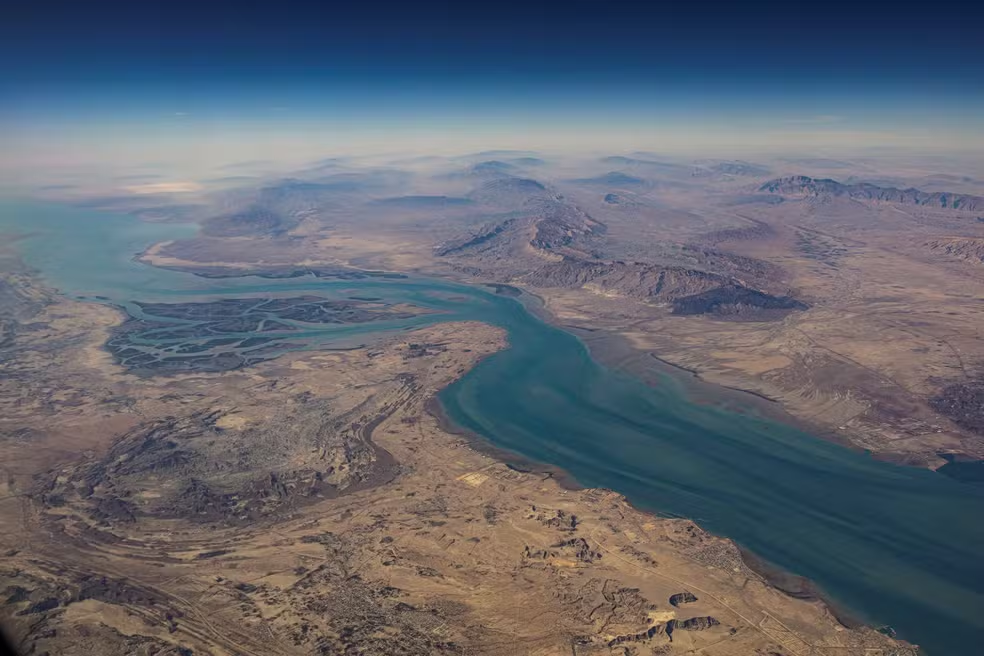
The escalation of fighting between Israel, the United States and Iran has led to the closure of the Strait of Hormuz, a strategic maritime corridor between Oman and Iran that serves as the main export route for Middle Eastern oil. The developments were first reported by g1.
The disruption has triggered fresh volatility in global energy markets. Analysts warn that prolonged restrictions on shipping could push fuel prices higher and intensify inflationary pressure worldwide.
Located at the mouth of the Persian Gulf, the Strait of Hormuz handles roughly 20% of the world’s traded oil. Tankers departing from major producers use the narrow passage to reach Asia, Europe and the Americas. As a result, any interruption quickly reverberates across global supply chains.
Energy markets reacted sharply. At the opening of international trading on Sunday night, oil prices surged about 13%, briefly climbing above $82 per barrel — the highest level since January 2025. Later in the morning, Brent crude was up more than 8%, while U.S. West Texas Intermediate gained nearly 8%.
A historic chokepoint with modern geopolitical weight
The Strait of Hormuz has long held strategic significance. In antiquity, it linked Persia, Mesopotamia and India to the Indian Ocean. During the 16th and 17th centuries, European powers competed for control of the area to secure maritime trade routes.
Its global importance deepened in the 20th century after vast oil reserves were discovered in the Persian Gulf. Following World War II, the strait became essential for transporting crude from the region to the rest of the world.
Tensions flared during the Iran-Iraq War in the 1980s, when oil tankers were targeted and the United States began escorting vessels through the Gulf. Since then, the waterway has remained a geopolitical flashpoint. Iran has periodically threatened to block it in response to sanctions or military confrontations, although prolonged shutdowns have historically been avoided.
Between early 2022 and May this year, an estimated 17.8 million to 20.8 million barrels of crude oil, condensate and refined products passed through the strait each day, according to maritime monitoring firm Vortexa.
Members of the Organization of the Petroleum Exporting Countries — including Saudi Arabia, Iran, the United Arab Emirates, Kuwait and Iraq — rely heavily on this route, particularly for exports to Asian markets. Qatar, one of the world’s largest exporters of liquefied natural gas, ships nearly all of its LNG through the same corridor.
Some countries have invested in alternative routes to reduce reliance on Hormuz. Saudi Arabia and the United Arab Emirates operate pipelines that bypass the strait. However, according to the U.S. Energy Information Administration, existing pipeline capacity provides only limited flexibility compared with total export volumes.
The latest conflict has also disrupted production in parts of the region. Qatar suspended LNG output after reports that a facility was hit by drones. Saudi Arabia temporarily closed its largest refinery in Ras Tanura for security reasons. In Iraqi Kurdistan, much of the oil production has been halted. Israel ordered shutdowns at major offshore gas fields, including Leviathan and Tamar. In Iran, explosions were reported near Kharg Island, a key export hub.
For financial markets, the central question is how long the navigation halt will last. If traffic resumes quickly, prices may retreat, though likely remain elevated. If the disruption persists, analysts warn that oil and gas could climb to new highs, increasing pressure on consumers and central banks already navigating fragile economic conditions.
As tensions deepen, the Strait of Hormuz once again underscores its role as a critical artery of global energy trade — and a barometer of geopolitical risk.