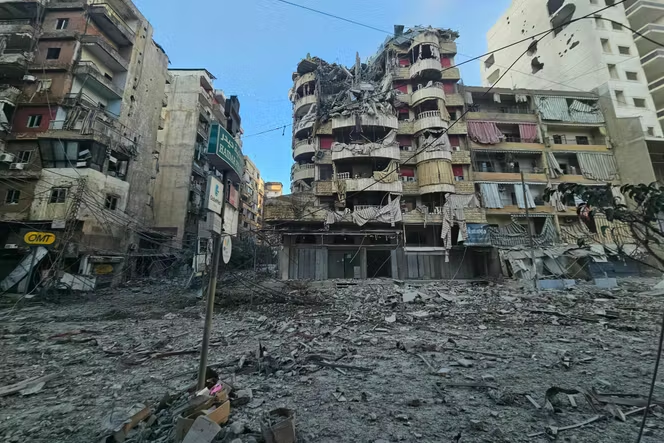
The rules are clear: parties in a conflict must distinguish between military targets and civilian objects. Direct attacks on civilian infrastructure are prohibited, especially when those targets are essential for survival.
That includes food supplies, water systems, agricultural areas and energy infrastructure that supports basic civilian needs.
International law explicitly states that actions must not leave populations without access to food or water, or force displacement through deprivation of essential resources.
When infrastructure becomes a war crime target
However, not every strike on infrastructure automatically qualifies as a war crime.
Facilities may be considered legitimate military targets if they make an “effective contribution” to military operations and their destruction offers a clear strategic advantage.
Still, even in those cases, the principle of proportionality applies. That means any expected civilian harm must not outweigh the anticipated military benefit.
If an attack knowingly causes excessive harm to civilians, for example, by cutting off electricity needed for hospitals or water systems, it may constitute a war crime.
These standards are also reflected in the Rome Statute, which governs prosecutions at the International Criminal Court.
Past cases show how courts interpret attacks
Recent cases provide insight into how these rules are applied.
The ICC has issued arrest warrants linked to attacks on civilian infrastructure in Ukraine, including strikes on power grids during winter. Prosecutors argued those actions deprived civilians of essential services.
Similarly, in cases related to Gaza, ICC judges have examined whether restricting access to food, water and electricity could amount to war crimes if done intentionally.
In both contexts, the key legal test is intent and impact — whether leaders knowingly targeted or deprived civilians of resources necessary for survival.
Why accountability is complex
Despite the legal framework, enforcement remains difficult.
Countries such as Iran, Israel and several Gulf states are not members of the International Criminal Court, limiting the court’s jurisdiction. Major powers like the United States, Russia and China are also outside its reach.
While the United Nations Security Council can refer cases to the ICC, political divisions often prevent such action.
Alternatively, some countries can prosecute war crimes under “universal jurisdiction” laws, but such cases remain rare and complex.
Big picture
International law draws a firm line: civilians and the infrastructure they depend on must be protected.
But in modern conflicts, where energy systems, ports and communication networks often serve both civilian and military roles, that line is increasingly blurred.
Ultimately, whether an attack becomes a war crime depends on a mix of intent, proportionality and consequences, and whether the international system is willing, or able, to enforce those rules.