
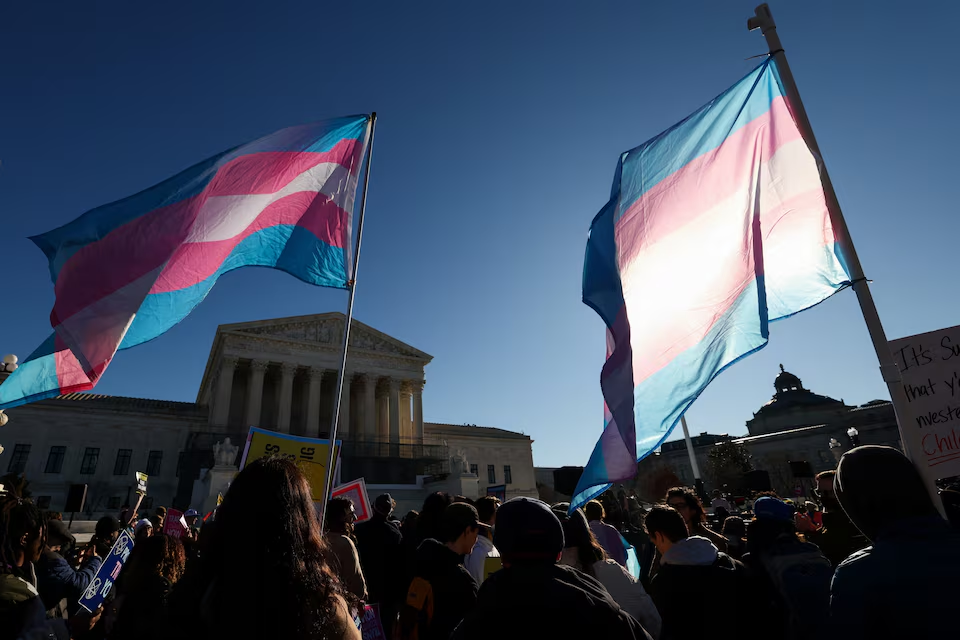
Several conservative justices on the U.S. Supreme Court appeared inclined on Tuesday to uphold state laws that bar transgender athletes from competing on female sports teams. The remarks came during lengthy oral arguments in cases from Idaho and West Virginia, placing the court at the center of one of the most contentious legal debates over gender identity and equal protection.
The justices reviewed appeals filed by the two states after lower courts blocked their laws, which restrict participation on girls’ and women’s teams based on what the statutes define as biological sex. Challengers argue the measures violate the U.S. Constitution’s guarantee of equal protection and Title IX, the federal law that bans sex discrimination in education. At least 25 states have adopted similar restrictions, raising the stakes of the court’s eventual ruling.
The cases unfolded against a broader political backdrop. The Trump administration urged the court to side with the states, continuing its support for policies that limit transgender participation in sports and other public settings. The court, which holds a 6–3 conservative majority, has already upheld several such restrictions in recent terms.
Justices divided over fairness, science, and federal law
During the arguments, conservative justices expressed concern about imposing a single national rule amid disagreement over whether medical treatments such as puberty blockers or hormone therapy eliminate physiological advantages linked to male puberty. Justice Brett Kavanaugh, who has coached girls’ basketball, emphasized what he described as the zero-sum nature of sports competition. He suggested that allowing transgender girls to participate could displace other athletes from teams, playing time, or awards.
Kavanaugh also pointed to Title IX’s history, noting that the law and its regulations have long permitted sex-separated teams. In his view, Congress, not the courts, should decide whether to alter that framework. Idaho’s solicitor general echoed that argument, telling the court that sex-based classifications remain central to maintaining fair competition for women and girls.
Liberal justices took a different approach. Justice Sonia Sotomayor said the bans plainly classify students by sex and therefore require heightened judicial scrutiny. She questioned whether the states had offered sufficient justification for excluding transgender athletes, especially when individual circumstances differ. Justice Ketanji Brown Jackson also signaled skepticism, noting that Congress described key amendments to Title IX as modest adjustments rather than sweeping changes.
Lawyers for the challengers argued that the laws discriminate against transgender students as a group and fail to account for medical evidence. One attorney said the Idaho plaintiff used hormone treatment that mitigated any alleged physical advantage, undermining the state’s rationale. State officials and the Trump administration countered that the laws apply regardless of individual treatment and that advantages persist despite medical intervention.
The potential impact of the cases extends beyond school athletics. Several justices acknowledged that the court’s reasoning could affect future disputes over transgender rights in areas such as military service, bathroom access, classroom treatment, and identity documents. The court’s prior decisions, including rulings on medical care for transgender minors and military service bans, loomed over the arguments.
A decision is expected by the end of June. If the court upholds the state laws, it could clear the way for broader enforcement of similar bans nationwide. If it rules for the challengers, states may face new limits on how far they can go in regulating transgender participation in public life.