
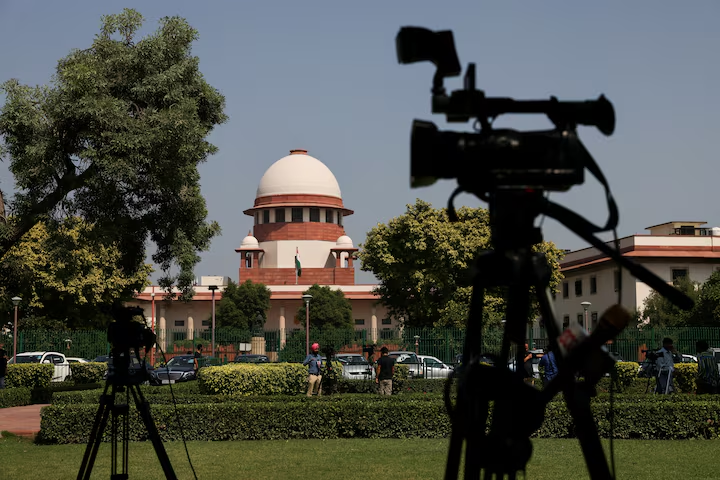
A sweeping decision by India’s Supreme Court has sent ripples through global investment circles, raising fresh concerns about tax certainty in one of the world’s fastest-growing major economies. The ruling, which went against U.S. investor Tiger Global, strengthens New Delhi’s power to challenge long-standing tax structures that routed foreign money into India through Mauritius, a route that has attracted billions of dollars over decades.
Foreign investors have channelled roughly $180 billion into India via Mauritius, drawn by a bilateral tax treaty that for years allowed capital gains from Indian share sales to escape taxation in India. That framework now faces a fundamental shift. In a closely watched judgment, the court held that Tiger Global’s $1.6 billion sale of its stake in Flipkart to Walmart in 2018 should be taxed in India, rejecting the argument that the deal qualified for treaty protection.
The judges said Indian authorities proved that Tiger Global used Mauritius-based entities as conduit companies to benefit from what they called an impermissible tax-avoidance arrangement. Tiger Global has consistently denied wrongdoing and has said it relied on valid treaty benefits, but it has not commented publicly since the ruling.
Treaty protection narrowed as court backs tax authorities
Legal experts say the decision marks a turning point because it allows Indian tax officials to look beyond formal structures and examine whether a transaction has genuine commercial substance. While India and Mauritius updated their treaty in 2017 to end the tax-free regime for new investments, older investments were supposed to remain protected under a so-called grandfathering clause. The Supreme Court made clear, however, that India’s general anti-avoidance rules can override treaty benefits if authorities show the structure existed primarily to dodge taxes.
That interpretation has unsettled investors who relied on Mauritius structures for years. Lawyers in Mumbai and New Delhi report calls from European and U.S. funds seeking clarity on how the 152-page ruling could affect past and future exits. Some warn that even historic deals could now face closer scrutiny if tax officials argue the underlying entities lacked real business activity.
The ruling also revives a familiar concern for investors in India: uncertainty over tax enforcement. Despite the country’s appeal as a growth market, disputes over treaty interpretation, import duties, and retrospective claims have often strained investor confidence. High-profile cases involving Volkswagen and Vodafone remain part of that backdrop, reinforcing fears of prolonged litigation.
Indian officials have pushed back on claims that the decision will deter investment. Additional Solicitor General N. Venkataraman said the focus on tax impact distracts from broader factors that drive investment decisions. Still, tax advisers caution that confidence rests heavily on predictability, and the court’s firm stance may prompt investors to reassess how they structure deals.
In blunt language, the Supreme Court underlined its reasoning, stating that treaty provisions cannot serve as tools to facilitate abuse. For global investors, that message signals a tougher environment, where long-accepted routes into India now carry greater legal and financial risk.