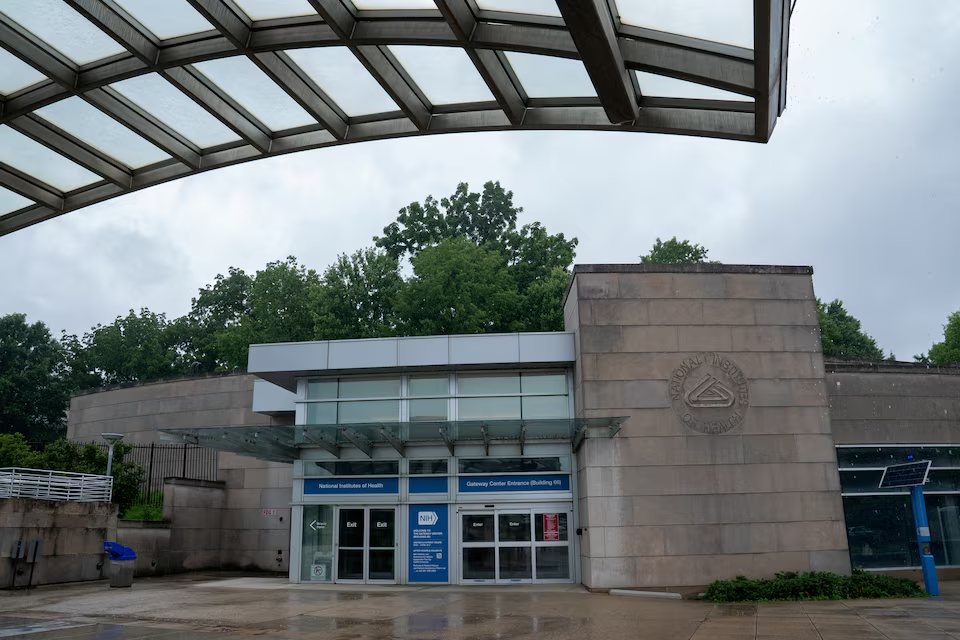
A U.S. appeals court has ruled that the Trump administration cannot move forward with sweeping cuts to research funding provided by the National Institutes of Health, dealing a setback to efforts aimed at reducing federal spending at major universities. The decision preserves billions of dollars in scientific and medical research support and reinforces limits set by Congress on how federal agencies may alter grant funding.
On Monday, a three-judge panel of the 1st U.S. Circuit Court of Appeals in Boston upheld an injunction that prevents the funding cuts from taking effect. The court agreed with challengers that the policy announced by National Institutes of Health in February 2025 violated existing regulations and congressional budget directives. The injunction was originally sought by attorneys general from 22 Democratic-led states, along with universities and major medical associations.
The ruling addresses one of several initiatives pursued by the administration last year that targeted federal research spending. As a result of those efforts, grants at multiple universities were frozen or canceled, raising concerns across the academic and medical research communities. The NIH did not respond to a request for comment following the court’s decision.
Court finds NIH policy conflicted with congressional limits
The disputed policy sought to cap so-called indirect costs at 15% of direct research funding. Indirect costs cover shared expenses such as facilities, equipment, utilities, and administrative staff that support multiple research projects. Under the new guidance, the cap would apply uniformly, regardless of an institution’s actual operating costs.
In announcing the change, NIH pointed to elite universities such as Harvard, Yale, and Johns Hopkins, which have charged indirect cost rates exceeding 60% while holding multibillion-dollar endowments. However, challengers argued that many institutions lack such financial reserves and rely heavily on negotiated reimbursement rates to sustain research operations.
Lawyers for the plaintiffs warned that enforcing the cap would trigger layoffs, shut down laboratories, and delay or cancel clinical trials. They also argued that the policy conflicted with funding legislation enacted by Congress since 2018, which expressly protects negotiated indirect cost rates.
U.S. District Judge Angel Kelley blocked the cuts last year, concluding that the policy violated both NIH regulations and congressional intent. The appeals court agreed. Writing for the panel, Judge Kermit Lipez said Congress had taken clear steps to prevent NIH from replacing negotiated reimbursement rates with a single uniform cap.
The ruling follows a series of similar losses for the administration. Courts have repeatedly blocked attempts to impose comparable 15% caps on research funding from the National Science Foundation and the U.S. Departments of Defense and Energy. Universities challenged those measures as well, and judges consistently sided with the plaintiffs.
The decision reinforces judicial limits on executive authority over federal research funding and underscores the role of Congress in setting binding conditions on how agencies allocate grant money. For universities and research institutions, the ruling offers short-term certainty as broader debates over federal spending and academic funding continue.