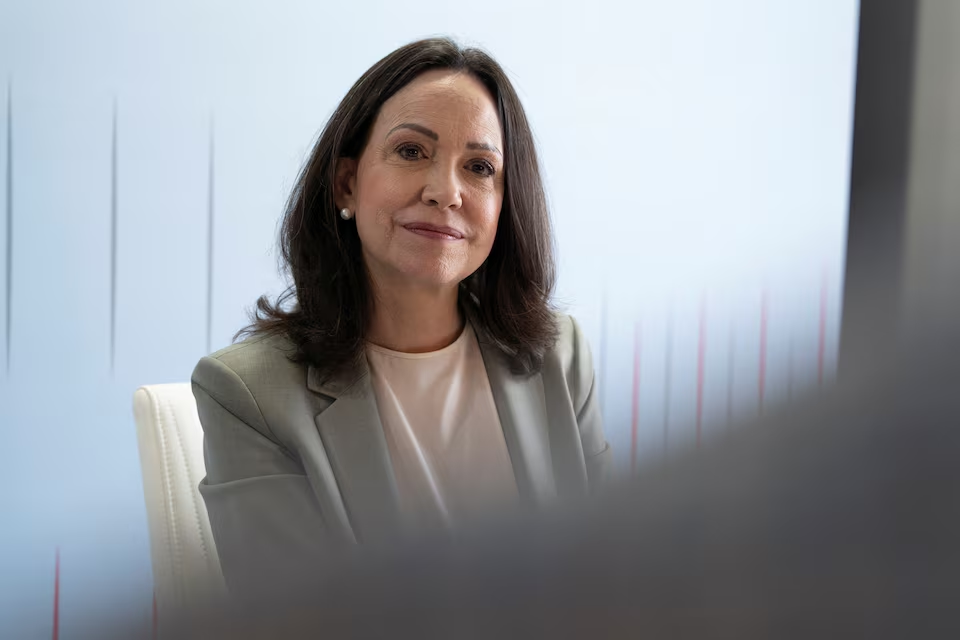
Venezuela opposition leader Maria Corina Machado traveled to Houston this week with a clear message. The country wants foreign investment in energy — but not without safeguards.
The Nobel Peace Prize winner spoke to Reuters ahead of her address at the CERAWeek conference on Tuesday. She welcomed the growing interest in Venezuela’s oil reserves. But she stressed that lasting investment demands stronger legal protections, transparent governance, and a new oil law.
“I’m here to attract attention to Venezuela, not delay it,” she told Reuters.
Earlier this year, Venezuela’s National Assembly passed a sweeping reform of the country’s oil legislation. The move followed the U.S.-backed removal of President Nicolás Maduro. The updated law gives foreign producers more freedom to operate and export crude independently. That marks a major shift for the OPEC nation. But industry leaders say the reform doesn’t go far enough. President Donald Trump’s target of $100 billion in investment will require deeper changes.
Machado laid out her own vision. She said Venezuela could eventually produce up to 5 million barrels per day. Reaching that level would require around $150 billion in investment. For that kind of capital to flow in, investors need functioning rule of law and enforceable contracts. She argued those conditions would only arrive in full once the country holds a proper presidential election.
In the meantime, she backed Washington’s role in overseeing oil revenue. She framed it as a safeguard against corruption. Since January, the U.S. Treasury Department has managed oil proceeds through controlled bank accounts. The interim government led by Delcy Rodríguez is working to restore output to 1.2 million barrels per day. That was the level before a strict U.S. blockade targeted Maduro’s regime.
Major oil companies remain cautious. ConocoPhillips CEO Ryan Lance also appeared at CERAWeek. He said Venezuela needs to “completely rewire” its fiscal framework. He called recent reforms “woefully inadequate.” The company left Venezuela after the government seized its assets in 2007. ConocoPhillips says it is still owed roughly $12 billion.
Even Chevron — the only U.S. major currently operating there — wants more legislative progress. CEO Mike Wirth said at the conference that key steps still need to happen before large-scale investment becomes realistic.
Spain’s Repsol struck a different tone. Francisco Gea, executive managing director of exploration and production, said Repsol plans to triple its gross crude output in Venezuela. The target: 150,000 barrels per day within three years.
When asked whether investors should talk to her or to the Rodríguez administration, Machado didn’t hold back. “It depends on whether you want to refer to the past, or to the future,” she said. “And then you make up your mind.” She added that elections would come soon. She also voiced full support for Washington’s current strategy.
Rodríguez has maintained that the country already offers enough protections. At a recent event in the presidential palace in Caracas, she told visiting investors they could count on legal certainty and political stability. She pointed to opportunities in both hydrocarbons and mining.
Machado used her speech at a packed conference hall to outline what a democratic government would offer. Investors could book reserves, access international arbitration, and tap into a newly opened electricity sector. She estimated elections would take about nine months to organize once called.
On PDVSA, the state oil company, Machado envisions a gradual reduction of its role. Operations would eventually shift to the private sector. But she drew a firm line on Citgo Petroleum, the Houston-based refiner that PDVSA owns.
“Losing Citgo would be damaging to Venezuela and an error for U.S. energy security,” she said.
An auction of Citgo’s parent company wrapped up last year. It still awaits final approval from the U.S. Treasury. Machado reached for a baseball analogy.
“Until the last out, in the last inning, there’s a possibility,” she said.