
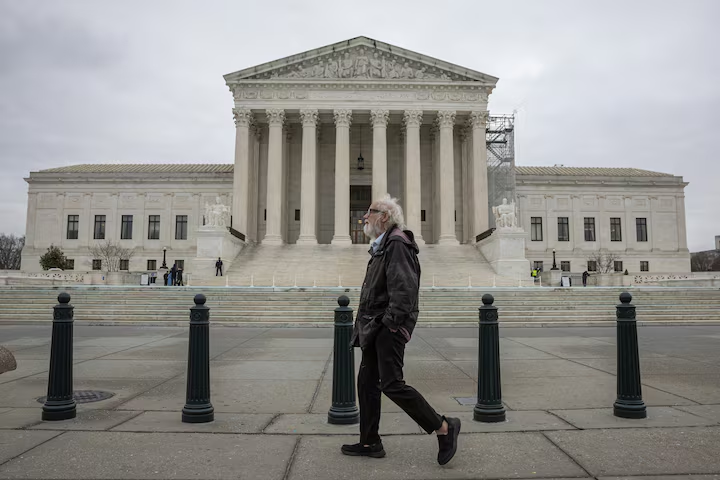
The U.S. Supreme Court stepped back into familiar territory Wednesday. The justices heard arguments over which workers can avoid forced arbitration in disputes with employers. At the center of this case sits a delivery driver who hauls Wonder Bread from Colorado warehouses to local supermarkets.
A Deepening Legal Split
The case arrived after the 10th U.S. Circuit Court of Appeals sided with the driver. That court ruled workers don’t need to physically cross state lines to qualify for an exemption under the Federal Arbitration Act. However, the decision deepened an existing split among federal appeals courts. As a result, Flowers Foods, the bakery giant behind Wonder Bread, appealed to the Supreme Court.
The stakes extend well beyond one driver’s wages. In fact, more than half of private-sector American workers have signed arbitration agreements. Additionally, companies across industries depend on delivery fleets within sprawling supply chains. Because arbitration typically blocks class action lawsuits, many individual wage claims simply aren’t worth pursuing alone.
The driver at the heart of the dispute, Angelo Brock, contracted with Flowers to move products on their final leg to store shelves. He sued the company over alleged misclassification. Specifically, Brock claimed Flowers labeled him and other drivers as independent contractors. This designation, he argued, denied them minimum wage and overtime protections. The 10th Circuit agreed and ruled the FAA exemption shielded him from mandatory arbitration.
Meanwhile, Flowers’ attorney Traci Lovitt argued Wednesday that Brock’s situation differs from a 2022 Southwest Airlines case. In that dispute, baggage handlers helped move goods between states. By contrast, Brock only enters the picture after interstate shipments conclude.
“Transportation ends when a good is unloaded,” Lovitt told the justices.
Justice Sonia Sotomayor pushed back immediately. “And that’s what Mr. Brock does as the last-mile driver for Flowers,” she responded.
Liberal Justices Express Skepticism
Throughout the hearing, the court’s three liberal justices appeared skeptical of Flowers’ position. Each emphasized that Brock ultimately delivers products that traveled through interstate commerce to their intended customers.
Jennifer Bennett, representing Brock, challenged Flowers’ reading of prior rulings. She argued the focus should rest on the nature of the work performed. The physical crossing of state lines matters less, she contended. Like the Southwest baggage handlers, Brock plays an essential role in completing interstate shipments.
Notably, Bennett has extensive experience in this legal area. She represented the plaintiff in the Southwest case. She also faced Lovitt in a 2024 dispute where the Supreme Court unanimously expanded the FAA exemption to any transportation worker.
More Litigation Ahead
Justice Neil Gorsuch suggested Wednesday that this won’t be the court’s final word. He flagged an unresolved question about workers who take legal ownership of goods during delivery. Do they still qualify for the exemption?
“And we will get to see you back here, again and again and again,” Gorsuch told Bennett.