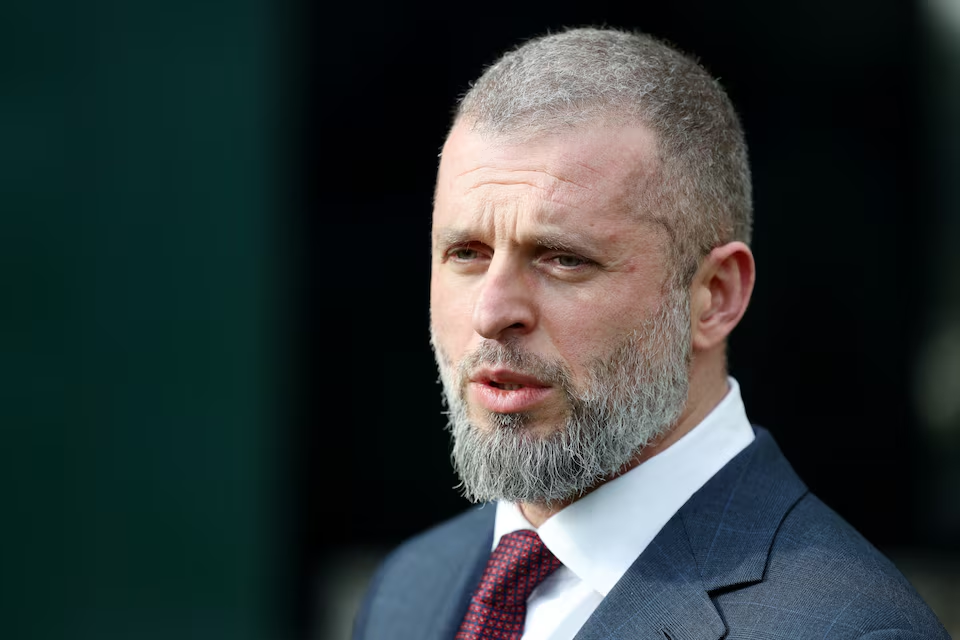
Ukraine’s sports minister has sharply criticized the decision to allow a limited number of Russian and Belarusian athletes to compete at the upcoming Paralympic Games, calling it “outrageous,” according to Reuters.
Matvii Bidnyi said Ukrainian officials will boycott the Milano Cortina Paralympics next month in protest. Ukrainian athletes will still compete from March 6 to 15, but no government representatives will attend the opening ceremony or other official events.
“In response to the Paralympics organisers’ outrageous decision to let Russians and Belarusians compete under their national flags, Ukrainian officials will not attend the Paralympic Games,” Bidnyi wrote on social media. He also urged other countries to follow suit.
The International Paralympic Committee (IPC) cleared six Russian and four Belarusian athletes to compete. Russia will have two athletes in para alpine skiing, two in para cross-country skiing and two in para snowboard. Belarus received four slots, all in cross-country skiing.
Tensions spill over into Olympic events
Both Russia and Belarus were banned from Paralympic competitions after Moscow’s 2022 invasion of Ukraine. However, member organizations voted in September 2025 to restore their full IPC membership rights.
International federations had initially maintained bans. Yet Russia and Belarus successfully appealed to the Court of Arbitration for Sport in December in a case involving the International Ski and Snowboard Federation. That ruling secured them a limited number of spots.
At the ongoing Milano Cortina Winter Games, athletes from the two countries are competing as neutral individuals, without flags or anthems. Their national Olympic committees remain sanctioned by the International Olympic Committee (IOC).
Bidnyi said allowing athletes to compete under national flags amounted to support for Russian propaganda. “The flags of Russia and Belarus have no place at international sporting events that stand for fairness, integrity, and respect,” he said.
The controversy intensified after Ukrainian skeleton racer Vladyslav Heraskevych was disqualified from the Winter Games over a helmet depicting Ukrainian athletes killed in the war. He later criticized organizers for allowing a Russian volunteer to carry a sign ahead of the Ukrainian delegation at the opening ceremony.
According to local media, the volunteer, a Russian living in Milan, condemned the invasion and wanted to show support for Ukraine. Still, Heraskevych questioned the broader decisions of sports authorities.
“It feels like the IOC is doing some campaign against the Ukrainian nation,” he told Reuters from Kyiv.
The IOC rejected accusations of discrimination. Spokesperson Mark Adams said all decisions followed the Olympic Charter, which limits expressions on the field of play. “We ask that from any country, from any athlete,” he said, adding that a Russian volunteer carrying a sign was not an issue.
Milano Games spokesperson Luca Casassa noted that more than 1,200 volunteers worked at the opening ceremony and said it was not feasible to vet each one individually.
As the Paralympics approach, the dispute underscores how the war in Ukraine continues to reverberate through international sport, even as organizers seek to maintain neutrality within the Olympic movement.