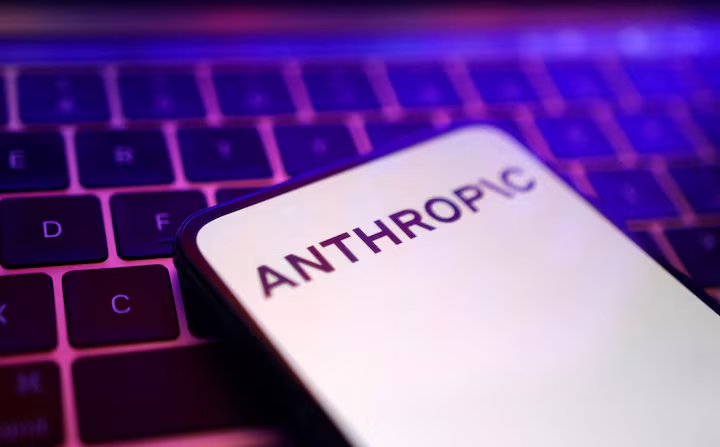
Anthropic is asking a federal judge in California to reduce a proposed $300 million legal fee award tied to its $1.5 billion copyright class action settlement. The company argues that part of the request goes far beyond what the work performed can reasonably justify.
The disagreement adds a new dispute to a case that already plays a central role in the legal debate over artificial intelligence and copyright law.
In a court filing submitted this week, Anthropic challenged fee requests from three law firms involved in the case. The company said those firms are seeking compensation that does not reflect their actual level of involvement. According to the filing, Edelson, Oppenheim + Zebrak, and Cowan DeBaets Abrahams & Sheppard are jointly asking for $75 million, despite not acting as lead counsel.
Dispute centers on role played by non-lead firms
The settlement, finalized in October, resolved claims from authors who accused Anthropic of using pirated books to train its AI models. Anthropic denied wrongdoing. Even so, the company agreed to pay $1.5 billion to end the litigation. It also agreed to destroy pirated datasets and confirm that those materials were not used in its commercial systems, including the Claude chatbot.
Attention has now shifted to how the settlement funds will be distributed. Lead attorneys from Susman Godfrey and Lieff Cabraser requested $225 million in legal fees. That amount represents roughly 20% of the total settlement. Anthropic did not dispute their leadership role. However, it warned that approving the full request without scrutiny could lead to excessive compensation.
Anthropic focused its objections on the additional firms. The company said Edelson and Oppenheim + Zebrak served as coordinating counsel and worked alongside the lead teams. Cowan DeBaets appeared as one of several firms listed on the case. For that reason, Anthropic urged the court to apply a steep reduction and closely review billing records before approving any payment.
The firms rejected Anthropic’s characterization. Edelson founder Jay Edelson said the company’s filing misrepresented the negotiations that led to the settlement. He described the request as disappointing, given his direct involvement in reaching the agreement. Oppenheim + Zebrak partner Matt Oppenheim echoed that view. He said his firm played a critical role in negotiating the $1.5 billion deal and rejected any suggestion that its contribution was minor.
Anthropic declined to comment publicly on the dispute. Lead attorneys for the class members also did not immediately respond to requests for comment. Still, the disagreement reflects a broader issue in large class actions. Courts often face pressure to balance fair compensation for lawyers with the interests of plaintiffs.
U.S. District Judge William Alsup, who is overseeing the case in San Francisco, will review the settlement and objections at a hearing scheduled for April. His decision could shape how future AI-related copyright cases handle fee awards.
The case is Andrea Bartz et al. v. Anthropic PBC, pending in the U.S. District Court for the Northern District of California.