
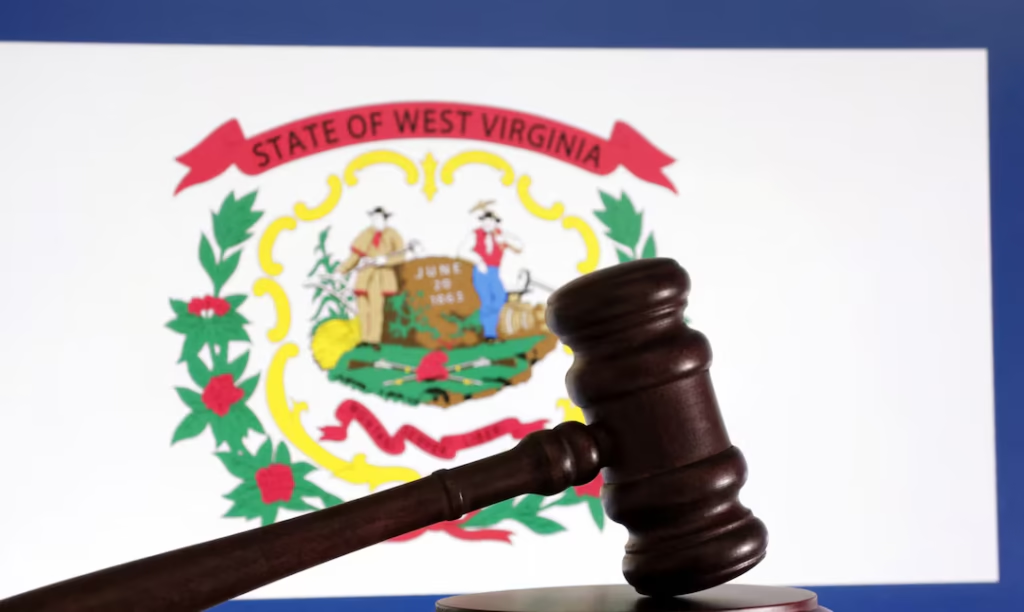
A federal appeals court in the United States has revived a $2.5 billion lawsuit against three of the nation’s largest drug distributors—Cencora (formerly AmerisourceBergen), McKesson Corp, and Cardinal Health—accused of fueling West Virginia’s opioid epidemic. The decision, first reported by Reuters, overturns a 2022 lower court ruling that had cleared the companies of liability.
Court overturns earlier ruling
The 4th U.S. Circuit Court of Appeals determined that the lower court in West Virginia misapplied state law when it found the distributors did not create a “public nuisance” by flooding Cabell County and the City of Huntington with opioid pills. The appellate panel ordered the case reopened to reassess whether the companies should finance addiction recovery and prevention programs.
According to the court, the distributors allegedly failed to flag and halt suspiciously large orders of prescription painkillers despite internal warnings. The ruling cited evidence that Cencora shipped 775 questionable orders from a single pharmacy over five years but reported only 16 of them to the U.S. Drug Enforcement Administration.
Local officials react
Huntington Mayor Patrick Farrell welcomed the decision, saying the city now has “a new opportunity to hold drug distributors accountable for the devastating harm they have caused.”
The three companies, which previously joined a $21 billion national settlement to resolve thousands of opioid-related lawsuits, declined to comment. Unlike many U.S. states and municipalities, Cabell County and Huntington opted out of the national settlement in hopes of securing a larger recovery tailored to their local crisis.
Broader legal implications
The revived case could set an important precedent for how courts interpret corporate liability under “public nuisance” laws in the context of public health crises. The distributors had argued that they fulfilled their legal obligations by reporting suspicious orders to regulators. However, the appellate court disagreed, finding that their compliance was inconsistent and inadequate given the scale of opioid shipments.
West Virginia has been one of the hardest-hit states in the U.S. opioid crisis, with overdose rates among the highest in the country. The renewed lawsuit may reopen the door for billions in potential damages aimed at addressing addiction treatment and community rehabilitation.






![Terry Rozier pleads not guilty to sports betting charges By Reuters December 8, 20257:45 PM GMT-4Updated 3 hours ago Item 1 of 3 Terry Rozier, a guard with the NBA's Miami Heat, departs the Brooklyn Federal courthouse, after entering a plea in a criminal case alleging he shared non-public information with sports bettors ahead of games, in Brooklyn, New York, U.S., December 8, 2025. REUTERS/Eduardo Munoz [1/3]Terry Rozier, a guard with the NBA's Miami Heat, departs the Brooklyn Federal courthouse, after entering a plea in a criminal case alleging he shared non-public information with sports bettors ahead of games, in Brooklyn, New York, U.S., December 8, 2025. REUTERS/Eduardo Munoz Purchase Licensing Rights, opens new tab December 8 - Facing federal wire fraud and money laundering conspiracy charges for his alleged role in an illegal sports gambling scheme, Miami Heat guard Terry Rozier pleaded not guilty in federal court Monday in New York. Rozier, 31, was released on a $3 million bond. Rozier's co-defendant, Deniro Laster, also appeared in court and pleaded not guilty. He was released on $50,000 bond. He and Rozier were arrested in October in connection with a federal investigation into illicit gambling. Advertisement · Scroll to continue In an indictment from the U.S. Justice Department, Rozier was accused of tipping off Laster that he planned to leave a game for the Charlotte Hornets game early by feigning an injury. Laster and other conspirators then used that knowledge to "place and direct more than $200,000 in wagers predicting Rozier's ‘under' statistics (i.e., that Rozier would underperform)." The NBA had previously investigated suspicious prop bets placed on Rozier's unders in 2023 but did not find evidence he had violated league rules. The league placed Rozier on leave following the indictment and his arrest. An investigation into Rozier has been underway since a March 23, 2023, game when Rozier played for the Hornets. Sportsbooks reported unusual betting activities on prop bets -- all on the under -- in a game Rozier left after 10 minutes, claiming a foot injury. Advertisement · Scroll to continue The indictment alleges Rozier made it known to associates that he would depart the game early, and more than $200,000 was wagered on the under, with a share of the winnings given to Rozier. With the next status update on the case set for March 3, Rozier's lawyer, Jim Trusty, told reporters he plans to file a motion for dismissal Tuesday. Evan Corcoran, Laster's lawyer, said he would likely do the same for his client. Trusty went on to say that he will meet with the NBA in an arbitration hearing on Dec. 17, per The Athletic, to contest that Rozier's leave is unpaid. The guard was placed on unpaid leave by the league one week after he was arrested, which caused the National Basketball Players Association to file a grievance with the league. Rozier entered the league as a first-round draft pick of the Boston Celtics in 2015. He is playing this season on the final year of a four-year, $96.3 million deal he signed with the Hornets and has $160.4 million in career earnings, according to Spotrac.](https://arbitrationmonitor.com/wp-content/uploads/terry-rozier-sports-150x150.avif)